Over time, assembling and revising your dynamic wealth (net worth) portfolio strategy is more than just picking stocks and bonds. Purchasing a home is both a spending decision and an investment decision. Any asset purchase that may change in value has to be incorporated into lifetime wealth management. Empty nesters heading into retirement may downsize to a less costly home or rent to have the sale proceeds to invest and live on. They may stay in a house and borrow against it to live on. A home is a real asset fixed until sold, but its value changes.
Furthermore, the method of financing is independent of the home’s value. During the inflation of 2021 through 2024, the rate of return on homes exceeded that of the stock and bond markets by many multiples. How can you not consider your home an investment for the future?
Mortgage debt or any other loan is a bond and should be treated as part of your bond portfolio. Debt value to you moves in the opposite direction of bond lending investments as interest rates change. Debt will offset some of the interest rate risk from your other bond investments. Furthermore, your bond portfolio should include Social Security, pensions, and annuities for analysis. Not considering them as bonds means you are overweight in your wealth portfolio without realizing it.
Anyone with private investments or small business income is likely holding an illiquid asset. Private investments are part of their stock portfolio. However, the expected return and risk characteristics may differ significantly from those of their exchange-traded stock investments. Private investments should be viewed as part of their stock portfolio; otherwise, the person is likely to be overweight stocks without realizing it.
The examples we just mentioned are why we define holistic wealth management as including all assets and liabilities in lifetime wealth (net worth) management.
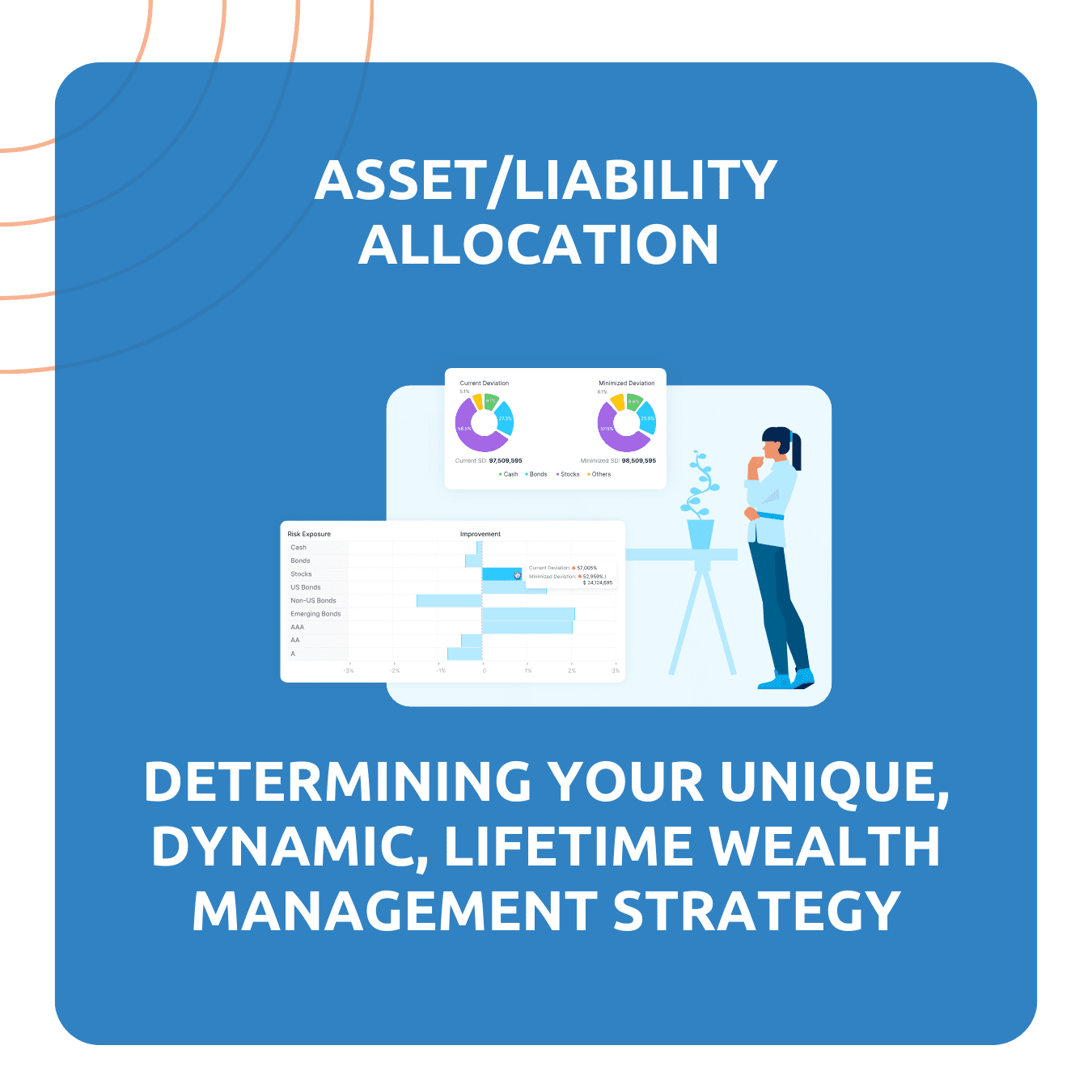
For a unique set of goals and opportunities, solving for the sizing (dollar amount) in each asset and liability allocation in a wealth portfolio is necessary to get the user’s most satisfactory lifetime tradeoff of expected wealth versus risk. This is where the combination of wealth planning and portfolio optimization comes in.
In the planning process, the user solves for a benchmark strategic asset allocation for their preferred Lifetime Expected Wealth versus Risk tradeoff consistent with achieving all their goals under what current financial markets are offering for the future. Then, the WealthFluent constrained optimization solves the decisions that minimize your actual wealth portfolio differences from your benchmark strategic asset allocation. This optimization methodology will simultaneously consider all the possible trade-offs within your wealth portfolio to make optimal joint decisions. Constraints are imposed implicitly or explicitly that a user wishes to impose.
Each asset and liability is treated as a single security account or part of a multiple security account. A home is typically a single security account that is unavailable for sale. Suppose you want to see the effect of selling your house before retirement or considering a move to another state for a job opportunity. In that case, you can use the dropdown menu to sell your home, move the proceeds to a brokerage account, and then optimize. This is how to remove a constraint explicitly.
The user can also put a hold constraint on any asset or liability within an account. Private company stock, restricted stock, and employee stock options may not be available to sell (they are illiquid). You can also make a measured tactical trade of individual security by selecting the amount invested and adding a hold constraint. Other constraints can be added to force specific securities into accounts for better tax treatment (tax location).
The WealthFluent Optimizer is a very flexible tool. You can add a constraint and reoptimize it to see its effect, add another constraint and reoptimize, or add all your known constraints and then optimize. Knowing what is in your wealth portfolio is readily available, but it is very difficult to understand what is not there that could reduce uncompensated risk (free diversification).
After each optimization, the WealthFluent Assist tool will analyze your wealth portfolio to see what opportunities are not there that you can add and reoptimize to get closer to your benchmark risk level. For example, you may strongly believe Apple stock is undervalued and want to overweight Apple stock compared to your benchmark. This is easily accomplished by adding Apple stock to an account, deciding on a measured amount for the overweight (i.e., $50,000), and putting a hold constraint on this investment. Then optimize.
The optimizer will work with this tactical constraint. However, the purpose of the constraint was an undervaluation based on Apple products and its management, not that it is also a large-cap growth stock. Those characteristics are not what the user should want to be overweight and increase risk. The Assist tool will pick this up and suggest adding other investments to offset this increase in risk. Large, mid, and small-cap value funds and large, mid, and small-cap growth funds will give the optimizer the flexibility and ability to make all the necessary trade-offs. Add and re-optimize. The same approach applies to private investments with specific characteristics like small-cap and growth. That means there could be an overweight in these particular characteristics. That means there needs to be less of these characteristics elsewhere or offset with other investments. The Assist tool will likely suggest adding small, mid, and large-cap value funds to reduce risk. Then re-optimize.
When we refer to WealthFluent as a dynamic process, it means that at every future date you sign in, all your account information and market data will be auto-updated. Security prices, interest rates, and risk dimensions are likely to have changed, and the allocation of wealth among each asset and liability. The magnitude of change is likely to be related to how long it has been since your last sign-in and the occurrence of a major market-moving event. Dynamic means immediately observing the effects of financial market information and any of your personal goals and circumstances on your lifetime wealth portfolio strategy and revising accordingly.
WealthFluent provides users with the tools to be in control throughout their lifetime!
Key Elements of Portfolio Optimization
- Asset/Liability Allocation:
- Portfolio optimization is a mathematical algorithm to solve for the optimal dollar allocation to each asset and liability in a Wealth Portfolio while maintaining all user constraints. You don’t need to know the mathematics in any detail, but your inputs to the optimizer are all your own choices. The user should scrutinize any algorithm output to see if it makes sense. If it doesn’t make sense, review inputs and re-optimize until you are satisfied. Diversification:
- Diversification is crucial to reducing risk in any portfolio, especially uncompensated risk. It involves spreading asset and liability available choices across various classes, sectors, and geographic regions to avoid over-concentration. The optimizer with the assist tool will do this for you. This is a very efficient tool with many assets and liabilities in many accounts with numerous goals.
- By diversifying, you minimize the impact of poor performance in one asset class, industry, or market, as gains in other areas can help offset losses.
- The Expected Return versus Risk Trade Off:
- The most important decision for a Lifetime Wealth Portfolio is finding the one, unique, expected wealth versus risk benchmark strategy that provides you the most comfort at this time. This is accomplished in the selection of a benchmark strategic asset allocation during planning and then implementing with the optimizer.
- Dynamic Wealth Portfolio Revision:
- Over time, the performance of different assets in your portfolio may cause your original asset allocation to drift. For example, if stocks outperform bonds, your portfolio may become more heavily weighted toward equities than initially intended. Thus, exposing you to more risk than originally intended. A wealth portfolio has a lot of moving parts across all assets and liabilities.
At any time in the future, you can sign in to WealthFluent, where all market and personal information gets auto-updated. Check Lifetime Wealth Planning to see if market changes have affected your choice of the Lifetime Expected Return versus Risk. If so, make any goal changes. Then select and save your most comfortable Expected Wealth versus Risk plan. Next re-optimize and implement trade results at your financial institutions..Here’s how WealthFluent helps you achieve these goals:
- Establish Your Financial Goals:
- Start by defining your short- and long-term financial goals. Are you saving for retirement, a home purchase, or another significant financial milestone? Your goals will be combined with what the financial markets are offering to choose a feasible expected wealth versus risk strategy that gives you the most comfort. These choices and your current wealth portfolio are critical as inputs to wealth portfolio optimization.
- Construct a Diversified Portfolio:
- The optimizer and assist tools solve for the maximum diversification benefit given all your goals, constraints and choice of Expected Wealth versus Risk comfort level.As inputs to the optimizer, the WealthFluent assist and screener tools provide access to all stocks, bonds, mutual funds, ETFs and money market funds, both domestic and international for diversification benefits to your wealth portfolio solution.
- Monitor and Adjust Your Portfolio:
- Once your portfolio is optimized, regular monitoring of its performance is essential. Market conditions change, and your portfolio’s asset allocation may drift away from your original plan.
- Are you on track to achieve goals comfortably or do you need to revise your strategy? This is where WealthFluent’s Portfolio Monitoring and Dynamic Wealth Portfolio Revision come into play.
Conclusion: A Smarter Approach to Wealth Portfolio Management
Over your lifetime, it is very unlikely that your asset/liability allocation will or should be static. There will be many financial markets and personal circumstances that lead to revisions in your wealth portfolio strategy.
It is interesting to hear institutions promote target date funds that systematically lower risk over time for retirement or college investment plans. They follow a predetermined strict rule without regard to changes in the investment landscape. If it were to make sense for one small investment in a much larger wealth portfolio, why not do that for their entire wealth portfolio. Setting future goals is fine. But doing so in isolated accounts is antithetical to the concept of diversification. If one goal falls short of expectation by $10,000, is that really a failure, if another isolated goal account exceeds expectation by $30,000 at the same time. Both goals are achieved with money left over. The focus should be on achieving all future goals from your wealth portfolio.
Dynamic Wealth Portfolio optimization is the key to achieving lifetime financial security. By focusing on the continuous monitoring of all the inputs and outputs of wealth portfolio management, the WealthFluent tools can be implemented to help you make your best choices under risk at any future date. Whether you’re new to managing your own wealth or a seasoned market participant, WealthFluent provides the Financial Planning, Constrained Optimization, Monitoring and Revision features to make smarter comprehensive decisions and stay on track for success.
Are you ready to optimize your portfolio and take control of your financial future?
Up Next
Stay tuned as we dive into the world of financial planning.